
Blog
Casa /

Blog

Sink Mark Improvement on Soft 65A TPU — A Practical Analysis Based on Remote Feeding and Thermal Shrinkage
October 12 , 2026
Background: 65 Shore A polyether-based soft TPU
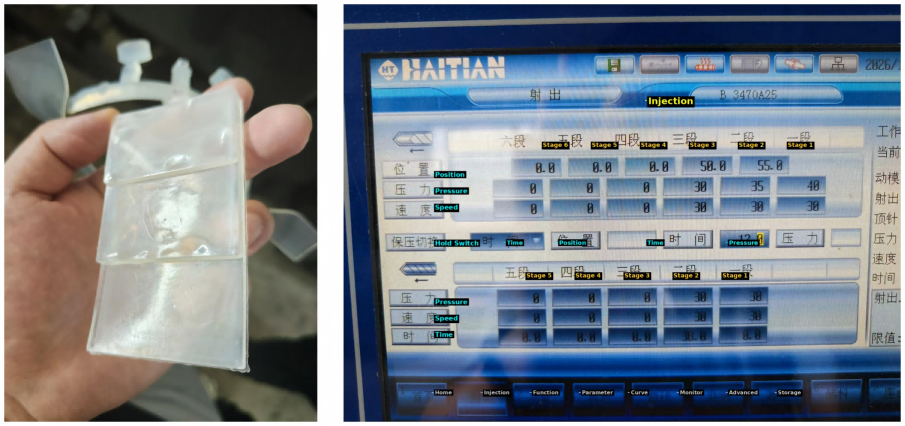
Defect: Extensive surface waviness and sink marks on the test specimen
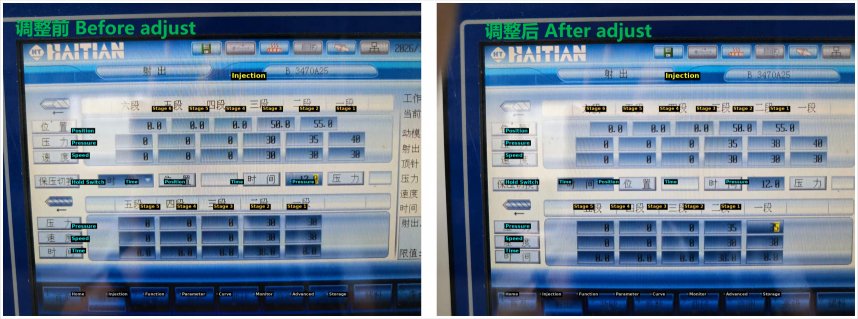
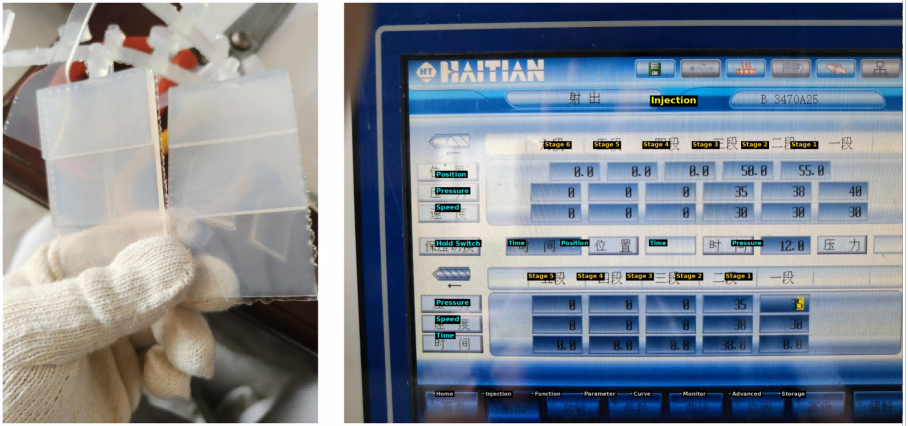
Adjustments: 2nd-stage injection pressure 35→38; 3rd-stage injection pressure 30→35; 1st-stage packing pressure 30→35; 2nd-stage packing pressure 30→35. Hold switch method and hold time (12.0s) remain unchanged.

Result: Flat specimen surface with sink marks eliminated.
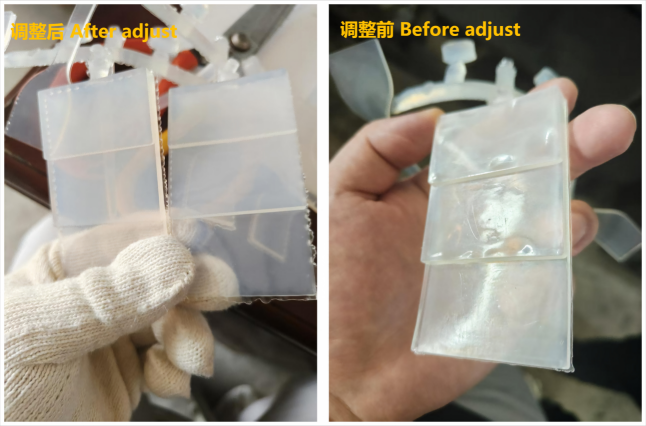

1. Debunking the Myth: Soft TPU Sink Marks Are Not Always "Rebound," But Often "Under-Feeding"
Many injection molding engineers instinctively attribute sink marks in soft materials to "excessive pressure causing elastic rebound," and thus try to reduce pressure. However, the real-world data from this case (where pressures were increased across the board) proves that: for thick-walled areas far from the gate, increasing late-stage injection and packing pressures is the correct solution for soft TPU sink marks. The core issue is insufficient packing compensation.

2. Core Mechanism: The Battle Between Remote Shrinkage and Packing Compensation
In simple, practical terms, the logic behind this sink mark is as follows:
  • Low Pressure in Remote Areas: As the melt flows from the gate to the far end, pressure continuously decays.
  • Soft Material Shrinks Easily: When high-temperature soft TPU enters the cold mold, it cools down and its volume decreases significantly (thermal shrinkage).
  • Packing Provides Compensation: As the volume decreases, packing pressure is required to feed additional material to fill the shrinking space.
  • Insufficient Pressure Fails to Fill: Before adjustment, packing pressure was only 30 bar. The force transmitted to the remote areas was insufficient to fully compensate for the shrinkage .
  • Increased Pressure Provides Enough Force: After increasing the packing and late-stage injection pressures (packing up to 35 bar, 3rd-stage injection up to 35 bar), the force became sufficient to push the melt into the remote areas, promptly filling the volume loss and eliminating the sink mark .


Supplementary Root Cause: Due to the poor thermal conductivity of soft TPU, the outer skin cools and solidifies first, while the inner core remains hot and shrinks. This temperature gradient creates a larger internal volume deficit. If the external packing pressure is insufficient, the internal shrinkage pulls the solidified skin inward, forming a sink mark.


3. Parameter Adjustment Breakdown

Parameter Stage

Before Adjust

After Adjust

Process Function

2nd-stage Injection Pressure

35

38

Increases mid-stage filling density,reserving material for later compensation.

3rd-stage Injection Pressure

30

35

Increases late-stage filling pressure toovercome flow resistance and push materialto remote areas.

1st-stage Packing Pressure

30

35

Critical compensation phase before gatefreeze-off; uses high pressure to fill internalthermal shrinkage.

2nd-stage Packing Pressure

30

35

Maintains compaction to prevent meltbackflow before gate seal, ensuringsufficient remote feeding.


4. Practical Risks in Soft TPU Molding
Although increasing pressure solved the sink mark in this case, secondary issues caused by high pressure must be guarded against:
  • Dimensional Increase & Flash Risk: Higher pressure increases internal residual stress. The part may slightly expand after ejection, and flash may appear on the parting line. Critical dimensions must be re-verified against tolerances.
  • Limits of Over-Pressurization: Soft TPU is compressible; higher pressure is not always better. Beyond a critical point, it will not only fail to compensate but may cause excessive stress near the gate and ejection marks (push marks).
  • Wall Thickness Sensitivity: The thicker the wall, the greater the temperature gradient and the more severe the internal thermal shrinkage. Thick-walled soft TPU parts particularly require sufficient packing force, but are also the most prone to internal stress.
5. Conclusion
The success of this process improvement proves that for sink marks in remote areas of soft TPU, the vast majority of cases are dominated by a "thermal shrinkage under-feeding" mechanism caused by temperature gradients. Engineers must break the mindset that "soft materials cannot handle high pressure," and moderately increase late-stage injection and packing pressures to establish effective pressure compensation. Only then can such surface defects be truly resolved.


deja un mensaje
deja un mensaje
Si Si está interesado en nuestros productos y desea conocer más detalles, deje un mensaje aquí, le responderemos lo antes posible.

Casa

Productos

acerca de

contacto