
The shank is the stiff insert between the insole and outsole, running from the heel toward the ball of the foot. Its job is to support the arch and, in many designs, control torsion in the midfoot. Get the material or the geometry wrong, and a shoe feels floppy by lunchtime or fights the foot's natural motion.
There is no single best material. The right choice depends on load, available thickness, desired flex and rebound, environment, and cost.
What Drives the Decision
•Body weight and load. A shank sized for an average adult may deflect or creep under heavier wearers. Define the maximum design load first.
•Thickness. Slim dress shoes leave very little vertical space. But stiffness depends on both material modulus and cross-section shape, so ribs, curvature and open-frame structures can deliver stiffness without extra thickness.
•Flex vs. rigidity. Safety and orthopedic shoes may need near-rigid shanks. Walking and sports shoes usually want support that still flexes and rebounds.
•Environment. Humidity, heat and cold all change polymer behavior. Moisture-sensitive materials can shift in stiffness and dimensions; some rigid materials become brittle in the cold.
•Cost and manufacturability. Per-pair cost, cycle time and tooling matter as much as peak performance.
The Main Materials
•Steel: high rigidity and puncture resistance, but heavy and thermally conductive. Common in work boots and heeled shoes.
•Fiberglass: light and non-metallic, used in safety footwear.
•Glass-fiber-reinforced nylon (PA6/PA66): very stiff and economical, but absorbs moisture, which changes its properties and dimensions over time.
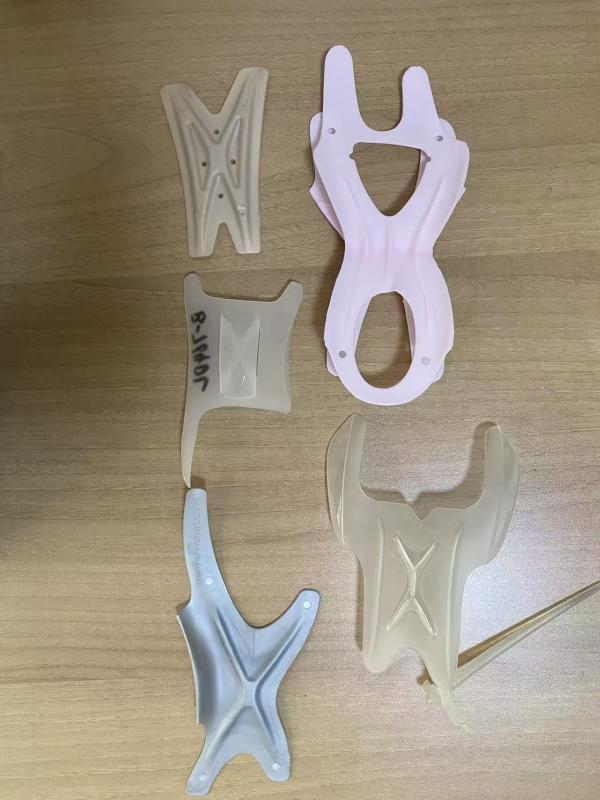
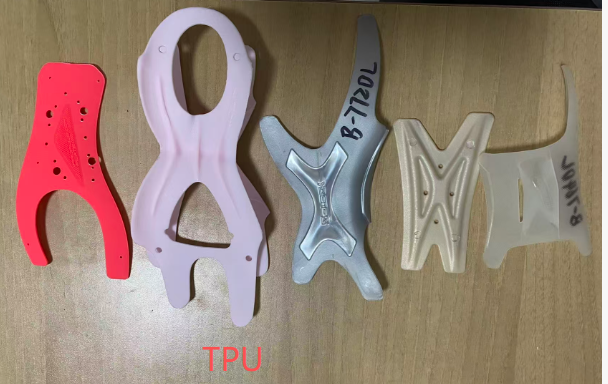
•TPU (thermoplastic polyurethane): tough, abrasion-resistant and flexible, with excellent rebound and flex-fatigue life. It is injection-moldable into complex 3D shapes (ribbed, X-shaped, perforated, multi-color or transparent), which lets designers tune bending and torsional stiffness through geometry. Polyether-based TPU adds strong hydrolysis and microbial resistance and good low-temperature flexibility, which suits humid, tropical and cold-climate use. Its stiffness ceiling is lower than glass-filled nylon, so very high loads in very thin sections call for a higher-hardness grade, a smarter structure, or reinforcement. Low-hardness grades should be checked for creep under sustained load.
•TPEE: a stiffer, more heat-tolerant elastomer with good fatigue behavior; typically costs more than standard TPU. Comparison with TPU depends on the specific grades.
•Carbon fiber composite: the highest stiffness-to-weight, and the highest cost.
Matching Material to Shoe Type
•Dress/casual: thin steel, nylon or TPU, depending on thickness and price.
•Everyday walking and athletic: TPU torsion and arch-support parts, balancing comfort, rebound and durability, often combined with TPU outsoles or midsoles for good bonding.
•Work and safety: steel, fiberglass or nylon where puncture resistance is required (a separate function from arch support, tested to separate standards); TPU for support and cushioning components.
•Heavy wearers or thin, high-performance designs: high-hardness TPU with an optimized structure, TPEE, or reinforced materials. Compare candidates on your own geometry.
•Cost-insensitive premium designs: carbon fiber.
Checklist Before You Commit
1.Maximum design load without permanent deformation?
2.Maximum thickness and allowed geometry (ribs, arch height)?
3.Required flex, rebound and torsional stiffness?
4.Cost ceiling per pair?
5.Humidity, temperature and storage/shipping conditions?
Datasheets reflect ideal lab conditions. Mold real samples at target geometry and test them: flexural properties (ISO 178 / ASTM D790), hardness (ISO 868), compression set (ISO 815-1), and a flex-fatigue test under realistic load and climate.
Dirección de correo electrónico
koslen@163.comNúmero de contacto
18900373733Habla a
Petrochemical light industry community,Wangchuan Town,Hui an County


Si Si está interesado en nuestros productos y desea conocer más detalles, deje un mensaje aquí, le responderemos lo antes posible.

 Compatible con red IPv6